
Someone is scrolling through Instagram and sees an ad for a service they are already considering. They have a question before they are ready to buy, but opening a website, finding the contact page and filling out a form feels like unnecessary effort. Then they notice the ad can take them straight into WhatsApp. One tap opens the conversation, and they can ask what they need to know immediately.
That shorter journey is what makes click-to-WhatsApp ads useful for many businesses. Instead of asking a prospect to move from an ad to a landing page and then find another way to contact the company, the ad can take them directly into a WhatsApp conversation. This works especially well for businesses where customers usually want to ask something before making a decision.
A property buyer may want to check availability. Someone interested in a service may need a quotation. A student may want to ask about the next intake, while a clinic prospect may simply want to know whether an appointment is available. These people may not be ready to complete a long form, but they may be perfectly comfortable sending a quick message.
The ad creates that opportunity. What happens after the click decides whether it becomes a useful lead.
What Are Click-to-WhatsApp Ads?
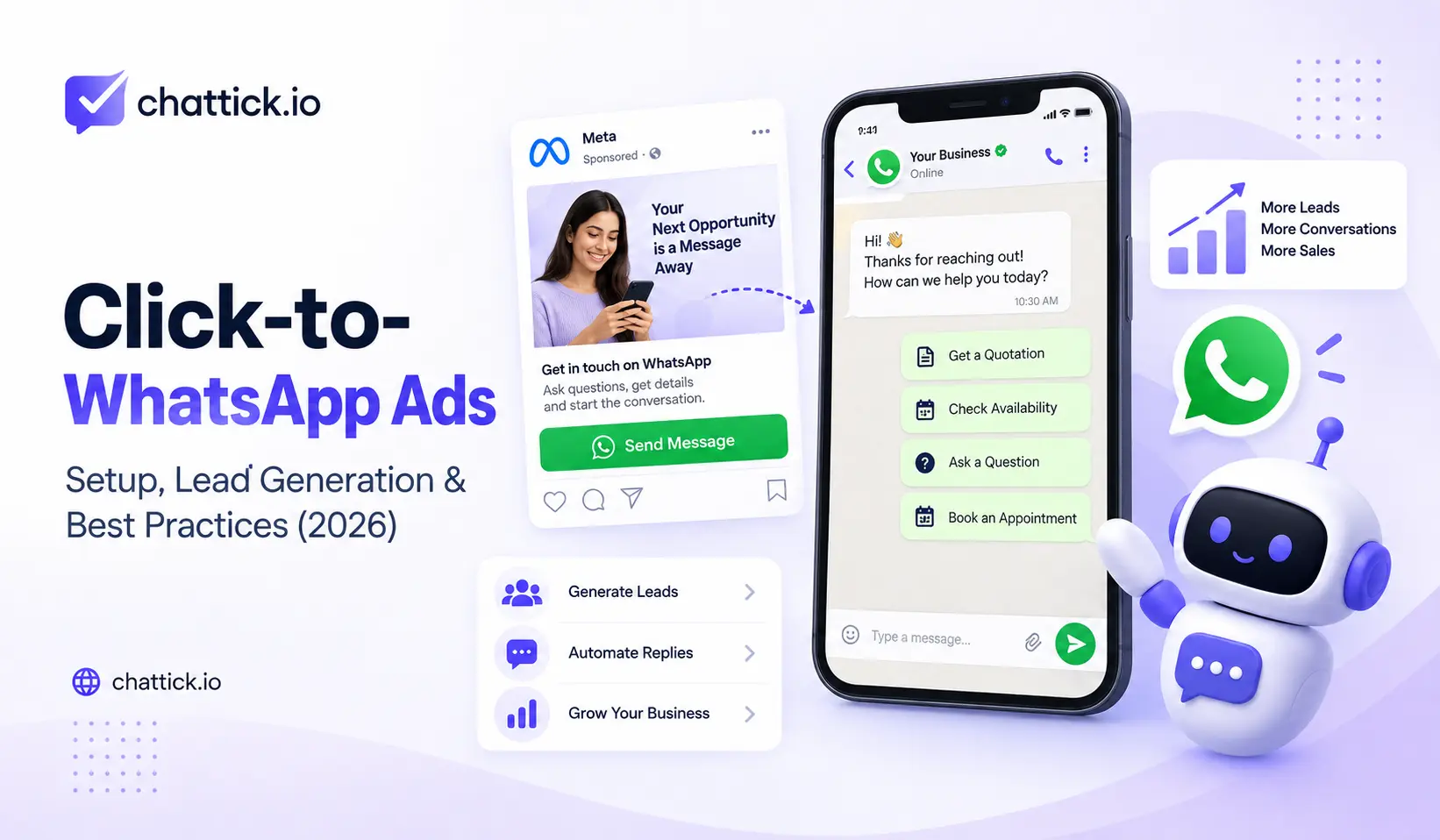
Click-to-WhatsApp ads are Meta ads designed to open a WhatsApp conversation when someone interacts with the call to action. A person sees the advertisement on a supported Meta placement, taps it and is taken into a chat with the business. Meta also uses the broader term ads that click to message for campaigns that send people from an ad into a messaging conversation.
The main difference from a normal website campaign is what happens after the click. A traditional journey may look like:
Ad → Website → Landing Page → Form → Sales Team
A WhatsApp-focused campaign can be shorter:
Ad → WhatsApp Conversation → Sales Team
That does not mean the shorter route is always better. A detailed landing page can still be useful when customers need more information before speaking with the business. WhatsApp becomes especially useful when conversation is already part of the buying process.
Why Send Someone to WhatsApp Instead of a Website?
People do not always need more information. Sometimes they only need one answer before deciding whether to continue.
A prospect may want to know whether a service is available in their city, whether a particular date is open or roughly what something will cost. Sending them through several pages may slow down a conversation that could have started immediately. WhatsApp gives them a familiar place to ask without making the process feel formal.
This works particularly well for services where customers usually have questions before buying. Instead of trying to explain every possible situation in the ad, the business can give enough information to create interest and let the conversation handle the details.
It can also make intent easier to see. Someone who watched an ad may be interested, but a person who clicked the ad and actually sent a WhatsApp message has taken another step. That does not automatically make them a qualified lead, but it gives the sales team more to work with than an impression or video view.
Clicks and Conversations Are Not the Same Thing
A person can click the ad, open WhatsApp and still never send a message. They may change their mind, get distracted or simply not know what to type once the chat opens.
That is why looking only at clicks can give the wrong impression of campaign performance. The business should also look at what happens inside WhatsApp.
Useful questions include:
- How many people actually start a conversation?
- How many conversations contain a genuine enquiry?
- How many leads meet the qualification criteria?
- How quickly does the team respond?
- How many conversations reach sales?
- How many eventually turn into appointments, quotations or customers?
The advertisement is only the first part of the funnel. A cheap click that goes nowhere may be less valuable than a more expensive click that regularly creates serious sales conversations.
When Click-to-WhatsApp Ads Make the Most Sense
Some products can be bought with almost no conversation. The customer understands the product, sees the price and completes the purchase.
Other buying decisions involve uncertainty. A customer may need to check eligibility, compare options, confirm availability, explain their situation or ask whether the business covers their location. These are stronger situations for WhatsApp advertising because conversation already sits somewhere between interest and purchase.
Common examples include:
- Professional services
- Education and admissions
- Property enquiries
- Clinics and appointment-based businesses
- Automotive services
- Home services
- B2B services
- Travel enquiries
- Higher-consideration ecommerce
- Local businesses offering quotations
The important factor is not the industry itself. It is whether speaking with the business helps the customer decide what to do next.
The Ad Creative Still Has to Do Its Job
Adding a WhatsApp button does not make a weak advertisement stronger. The creative still needs to stop someone from scrolling and give them a reason to care.
A good ad usually focuses on one clear idea. It might highlight a specific problem, offer, service, appointment opportunity or product. The customer should understand what is being offered and why it may be relevant before they reach WhatsApp.
The mistake is making the ad vague because the sales team can “explain everything in the chat.” That often attracts people who are curious but not particularly interested in the actual offer.
Before clicking, the prospect should have a reasonable idea of what the business offers, who it is for, why it may be useful and what they can do next. WhatsApp should continue the journey rather than restart the entire explanation.
Give People a Reason to Message
“Contact us on WhatsApp” works as a call to action, but it does not tell the customer why they should message.
More specific CTAs can feel much more useful:
- Check availability on WhatsApp
- Ask for a quotation
- See which option fits your business
- Book a consultation
- Ask about the next intake
- Check whether we cover your area
The call to action should match what actually happens after the person sends the message. If an advertisement promises an instant quotation but the company cannot provide one without several days of review, the campaign starts with the wrong expectation.
The best CTA is not necessarily the most exciting one. It is the one that accurately describes the next step.
What Should Happen When the WhatsApp Chat Opens?
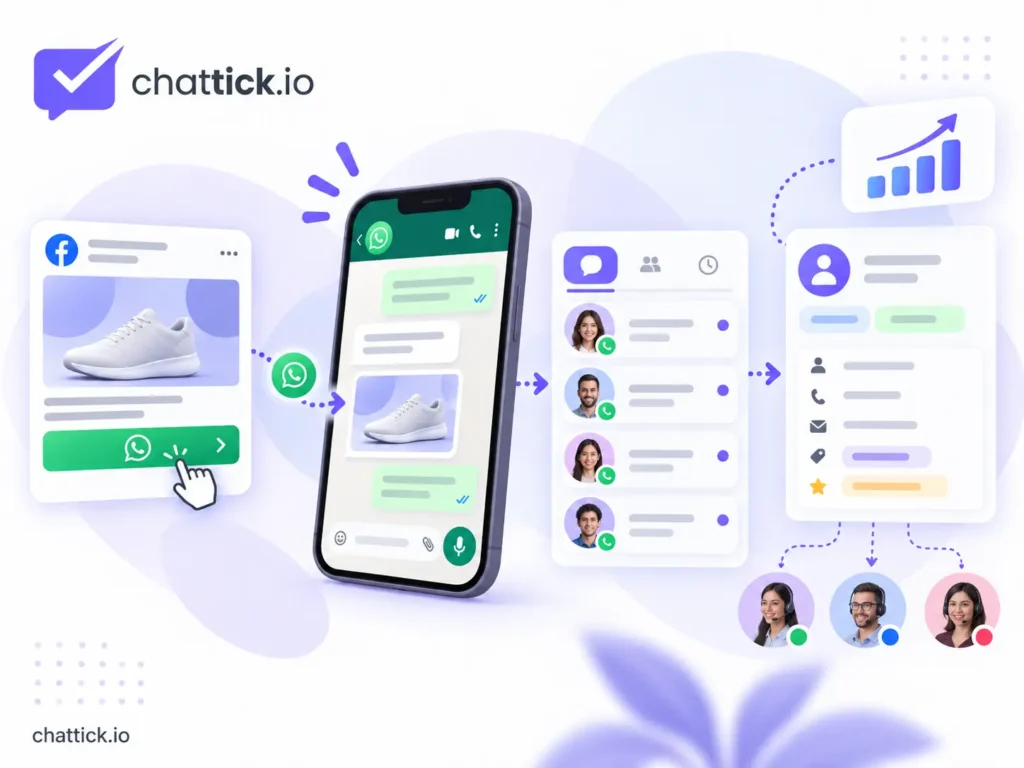
Imagine someone clicks the ad and enters WhatsApp, only to see an empty conversation. They now have to decide what to type, even though the business already knows which ad brought them there.
That small moment can create unnecessary friction. Where the campaign setup allows it, the opening experience should make the next step obvious. A suggested starting message or a simple first question can help move the conversation forward.
Someone arriving from an appointment campaign could start by asking about availability. A quotation campaign could make it easy to say which service they need. The opening does not need to be clever; it simply needs to continue the context created by the ad.
The customer should not have to repeat information the advertisement already made obvious.
Keep the First Response Short
A prospect clicked because messaging felt easy. Sending them a huge automated welcome message can immediately make the experience feel heavy.
There is rarely a need to explain the company history, every service, opening hours, pricing model and company mission in the first response. A short acknowledgement followed by one useful question is often enough.
If the campaign is already about a specific service, the business has some context. Ask for the next piece of information needed to help the customer.
The purpose of the first reply is to keep the conversation moving, not to recreate the website inside WhatsApp.
Response Speed Matters
People usually expect WhatsApp to feel more immediate than a website form. That changes the way delayed responses are perceived.
This does not mean employees must be online all day and night. It does mean the business should manage expectations properly. If the team is offline, a short automatic acknowledgement can tell the customer when someone will respond.
During working hours, advertising enquiries should ideally be routed to someone who can act on them. There is little value in spending money to generate conversations if interested prospects regularly sit in an inbox for several hours without a meaningful response.
Automation Can Handle the Repetitive Part
A successful campaign can create a sudden increase in conversations. That becomes difficult if every salesperson has to ask each lead the same basic questions manually.
Simple automation can help with the first few steps. A service business might need to know the type of service, location and preferred start date. A B2B company may need company size and current system. An education provider may ask about the course or destination the person is interested in.
The goal is not to turn WhatsApp into another long lead form. The idea is to collect just enough information for the team to understand the enquiry and decide what should happen next.
Three useful questions can often do more than a complicated chatbot with fifteen steps.
Do Not Put a Bot Between a Hot Lead and Sales
Automation can become a problem when the customer is clearly ready to speak with someone but the workflow keeps asking questions.
Suppose a prospect writes, “I’m ready to book. Can someone call me?” If the bot responds with another menu, then asks for their name, email, location and budget before letting them through, the automation is no longer saving time for the customer.
Strong workflows need clear handoff rules. When someone asks for a person, shows strong buying intent or reaches a point where judgment is needed, the sales team should be able to take over quickly.
Automation should remove repetitive work. It should not create another obstacle.
Lead Qualification Should Match the Offer
Different campaigns need different information.
A local service advertisement may only need the postcode and the type of job. A B2B automation campaign may need company size, current systems and the main problem the prospect wants to solve. A property campaign might need budget, location and property type.
Ask only for information that helps the business decide what to do next. There is no benefit in collecting extra details simply because the chatbot software provides more fields.
Every question creates another chance for the customer to leave the conversation. Keep qualification useful and short.
CRM Integration Makes the Leads Easier to Manage
When WhatsApp leads remain only inside individual chats, managing them becomes harder as volume grows. One salesperson answers a conversation, another handles the next, someone forgets to follow up and managers struggle to understand which leads came from advertising.
Connecting WhatsApp with a CRM gives those conversations more structure. A new contact can be created automatically, lead source can be saved, qualification answers can update the record and ownership can be assigned to the right salesperson.
WhatsApp remains the place where the customer communicates. The CRM becomes the place where the business keeps track of the opportunity and what happened next.
Keep the Original Lead Source
It is surprisingly easy to lose track of where a WhatsApp enquiry came from.
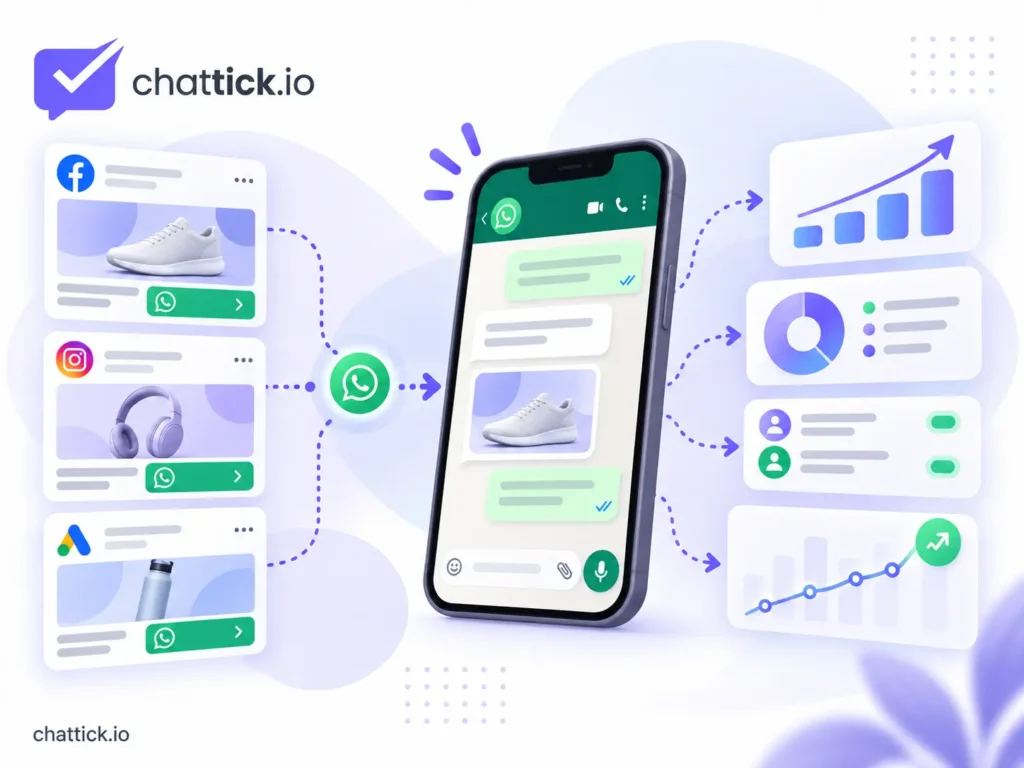
If several campaigns are running at the same time, the sales team should not need to ask every prospect, “Which ad did you see?” Where the setup supports it, campaign or source information should be carried into the lead-management process.
That information becomes useful later. The business can compare which creative produced better leads, which campaign generated conversations but few sales and which offer attracted the wrong audience.
Without source tracking, all WhatsApp enquiries eventually look the same.
Make Ownership Clear
A shared inbox can still become messy when everyone can see a lead but nobody knows who is responsible for it.
The business should decide how new advertising conversations are assigned. That may be round-robin distribution, territory-based ownership, department routing or assignment based on the service selected during qualification.
Existing customers may already have an assigned salesperson or account manager. In that case, the system may send the conversation directly to that person.
The exact rule is less important than having one. A paid lead should not sit unanswered because several employees assumed somebody else was handling it.
Follow-Up Is Part of the Campaign
A lead does not automatically become worthless because they stop replying after two messages. They may be busy, comparing options or waiting to discuss the decision with someone else.
A sensible follow-up process prevents good opportunities from disappearing simply because a salesperson forgot to return to the conversation. That may involve an internal reminder, task or an appropriate later message where the business has the required permission and the communication follows WhatsApp’s current rules.
The aim is not to chase people endlessly. It is to make sure interested prospects do not disappear because the internal process was inconsistent.
WhatsApp and Landing Pages Can Work Together
Businesses do not always have to choose between WhatsApp and a website.
A complicated service may still benefit from a detailed landing page that explains how the offer works. Once the customer understands the basics, WhatsApp can become the place where they ask specific questions.
A simpler campaign may work perfectly well going directly from the ad into a conversation.
Use the shortest journey that still gives the customer enough information to make a useful decision. Removing a landing page only helps if the page was adding unnecessary friction.
Focused Ads Usually Create Better Conversations
One broad campaign advertising everything the company does can lead to vague conversations. More focused ads usually give both the customer and the sales team better context.
Instead of advertising “All Our Services,” one ad can address a particular service or problem. Another campaign can speak to a different customer type.
When the person enters WhatsApp, the business already has a reasonable idea of what interested them. This can make qualification shorter and the sales conversation more relevant.
Specific advertising often leads to more specific enquiries.
The First Question Matters
The opening question can influence the direction of the entire conversation.
“Hi, how can we help?” is broad and sometimes completely fine. A targeted campaign may benefit from something more specific.
A property campaign could ask which area the customer is interested in. A B2B campaign might ask how many people are on the team. A local service business could ask what type of job is required.
The first question should be easy to answer and directly connected to the advertisement. It should not feel like the beginning of a long application form.
Click-to-WhatsApp Ads for Local Service Businesses
Local services are a natural fit because customers often want a quick answer before booking.
A homeowner may need to check whether a repair company covers their area. Someone looking for an automotive service might want to know the earliest available appointment. Another prospect may simply want an estimate before deciding whether to continue.
A basic WhatsApp workflow can collect location, service type and preferred time before sending the enquiry to the correct employee. For many local businesses, good routing and fast responses are more valuable than sophisticated AI.
The customer usually wants an answer. The system should help them reach someone who can provide it.
Click-to-WhatsApp Ads for B2B Companies
B2B customers often take longer to make decisions, so one advertisement may not be enough to generate a sales meeting. A prospect may still be willing to ask a question, though.
WhatsApp can work well when the campaign focuses on a specific business problem rather than a broad service category. An automation company, for example, may get better conversations from an ad about missed leads or slow follow-up than one simply advertising “AI Automation Services.”
The initial WhatsApp conversation can gather a small amount of context before sales gets involved. B2B qualification may require more information, but the prospect should still receive value before being asked for everything.
Click-to-WhatsApp Ads for Education Businesses
Education enquiries often contain questions that are difficult to answer with one generic page.
A student may want to know whether they meet an entry requirement, whether an intake is still open or which course may suit their background. WhatsApp gives advisors room to understand that situation without asking the student to navigate several pages first.
The advertising should still be specific. A campaign focused on a particular destination, intake or type of programme usually creates a clearer conversation than a broad “Study Abroad” ad.
Once the student starts chatting, basic qualification can collect the information an advisor needs to continue.
Click-to-WhatsApp Ads for Appointment-Based Businesses
Clinics, consultants, salons and other appointment-based businesses can use WhatsApp to move interested prospects toward a booking.
The customer may first ask about a service. Once that question is answered, the conversation can move naturally toward checking availability or collecting a preferred day and time.
If WhatsApp is connected with a real booking system, the process can become even smoother. The important thing is that the advertisement and operational process should match. Promising fast booking makes little sense if the customer still waits days for confirmation.
Creative Testing Still Matters
Using WhatsApp as the destination does not change the basics of advertising. Different creatives will still produce different results.
Test meaningful differences rather than tiny cosmetic changes. One ad may focus on the customer’s problem, another on the outcome and another on a specific offer. Video may work better for one audience while a simple static image performs better for another.
The important comparison is not only which ad produces cheaper clicks. Look at which one produces better conversations and better leads.
Do Not Optimize Only for Cheap Conversations
A campaign can generate lots of messages and still perform poorly.
Imagine one ad produces 200 conversations, but most people are not suitable for the service. Another creates only 80 conversations, yet half of those leads meet the company’s qualification criteria.
The second campaign may be far more valuable.
Useful metrics include:
- Cost per conversation
- Cost per qualified lead
- Qualification rate
- Appointment rate
- Quotation rate
- Sales conversion rate
- Revenue per lead
- Response time
- Follow-up rate
The closer the metric gets to actual business value, the more useful it becomes.
Define What a Qualified Conversation Looks Like
Not all messages have the same value.
“Price?” is technically a conversation. So is a message from somebody explaining their exact requirement, timeframe and company size. The two leads should not automatically be treated as equal.
Create a simple definition of a qualified lead. A local service company may care about location, service type and timing. A B2B company may need company size, need and budget.
Once that definition is clear, marketing and sales can judge campaign quality using the same standard.
Use WhatsApp Conversations to Improve the Ads
The sales inbox can also tell the marketing team what needs to change.
If many prospects ask the same question, the advertisement may be missing important information. If people regularly misunderstand the offer, the creative may need clearer wording. If customers repeatedly mention the same problem, that issue may deserve its own campaign.
Marketing should not only send leads into WhatsApp. Useful information from those conversations should also come back into future campaign decisions.
Make the WhatsApp Business Profile Look Credible
For some prospects, clicking the advertisement may be the first time they see the company inside WhatsApp.
The profile should make it obvious that they reached the correct business. The company name, profile image, description and available contact information should be complete and consistent with the advertisement.
Paid advertising creates a first impression before the conversation begins. A professional ad followed by an incomplete or confusing WhatsApp profile can create unnecessary doubt.
Permission Still Matters After the First Conversation
A person starting a WhatsApp conversation does not mean the business has unlimited permission to message them forever.
Any later follow-up or promotional communication still needs to respect WhatsApp’s current messaging and opt-in requirements. A genuine enquiry should not automatically place someone into an endless promotional campaign.
Good follow-up is based on relevance, timing and permission.
Common Click-to-WhatsApp Ads Mistakes
Many campaigns lose performance after the advertisement has already done its job.
Common problems include:
- Sending people into an empty conversation
- Using vague ads that attract the wrong audience
- Responding too slowly
- Asking too many qualification questions
- Sending oversized automated welcome messages
- Making it difficult to reach a salesperson
- Failing to save leads in the CRM
- Losing campaign-source information
- Having no follow-up process
- Measuring clicks rather than qualified leads
- Using the same chat flow for every campaign
- Sending later messages without appropriate permission
Most of these are not advertising problems. They are sales-process and customer-experience problems that advertising exposes.
How to Plan a Click-to-WhatsApp Campaign
Before building the campaign, decide what should happen after the customer sends their first message.
A simple lead-generation journey might look like this:
- The prospect sees an advertisement for one clear offer.
- They tap the CTA and enter WhatsApp.
- The conversation begins with a relevant question.
- Two or three qualification details are collected.
- The CRM contact is created or updated.
- The enquiry is assigned to the appropriate salesperson.
- Sales continues the conversation.
- Follow-up is scheduled if the prospect does not decide immediately.
- The final outcome is recorded in the CRM.
This keeps advertising and sales inside one connected process rather than treating WhatsApp as the end of the marketing campaign.
How to Set Up Click-to-WhatsApp Ads
The exact screens inside Meta Ads Manager can change, but the planning process stays fairly similar.
1. Prepare the WhatsApp Business Setup
Make sure the business number, profile and required Meta assets are correctly configured before sending paid traffic.
2. Decide What the Campaign Should Produce
“More WhatsApp messages” is too broad. Decide whether you want quotation requests, appointments, qualified leads or another specific type of enquiry.
3. Build a Focused Ad
Choose one audience problem or offer. Make it clear what the person will get by starting the conversation.
4. Use WhatsApp as the Messaging Destination
Configure the campaign so the relevant ad interaction leads into the company’s WhatsApp conversation where supported by the current campaign setup.
5. Prepare the Opening Conversation
Decide what the customer should see or send first. Keep it connected with the advertisement they clicked.
6. Add Qualification Only Where Needed
Collect enough information to make the lead useful without turning WhatsApp into a long form.
7. Connect Lead Management
Where possible, send the enquiry into the CRM and retain source information.
8. Define Ownership
Decide who receives the conversation and what response time is expected.
9. Test Everything
Click the actual advertisement and complete the journey yourself. Check WhatsApp, automation, CRM updates and human handoff.
10. Measure Beyond the Click
Review qualified leads, appointments, opportunities and sales instead of relying only on ad-platform engagement.
Test the Campaign Like a Real Customer
Do not stop testing when WhatsApp opens successfully.
Send the message. Answer the qualification questions. Ask something unexpected. Try to reach a person. Check whether the lead appears in the CRM and whether the right employee gets notified.
Also test what happens outside normal working hours and what happens when the customer gives an answer the workflow did not expect.
The complete journey matters more than the button working.
When Click-to-WhatsApp Ads May Not Be the Best Choice
Not every advertising campaign needs a conversation.
If customers can easily understand and purchase a product online, sending them into a chat may add unnecessary friction. Some complicated products may also require more education before a conversation makes sense.
A business that cannot respond consistently to WhatsApp leads should also fix that problem before spending heavily on this campaign type.
Use WhatsApp when conversation improves the buying process, not simply because the destination is available.
Click-to-WhatsApp Ads Best Practices for 2026
Start with a clear offer so the customer knows why they are opening WhatsApp. Keep the opening exchange short, ask only the qualification questions that genuinely matter and give high-intent prospects a quick route to a real person.
Make lead ownership clear inside the team and use honest after-hours responses when nobody is available. Where possible, connect conversations with the CRM, retain the source of each lead and build follow-up into the process instead of depending on memory.
Most importantly, judge the campaign by lead quality rather than message volume. A campaign producing fewer conversations but more genuine opportunities may be considerably more profitable than one generating hundreds of cheap enquiries.
Frequently Asked Questions
What is a click-to-WhatsApp ad?
It is an advertisement that takes someone from the ad into a WhatsApp conversation with the business. This gives the prospect a quicker way to ask questions or begin an enquiry.
Do customers need to complete a form first?
Not necessarily. The customer can usually begin by messaging the business, and any required information can then be collected during the conversation.
Are click-to-WhatsApp ads useful for lead generation?
They can be especially useful when customers usually have questions before buying. Results depend on the ad itself, response speed, qualification process and how well the business follows up.
Can a chatbot respond to leads from WhatsApp ads?
Yes. A chatbot can handle simple opening questions, qualification or routing. It should still allow an easy handoff when the customer needs a real person.
Can WhatsApp ad leads be sent to a CRM?
Yes, when the CRM and WhatsApp setup are appropriately integrated. This makes it easier to track ownership, source, qualification and follow-up.
Should every lead receive an automated reply?
No. Automation should only be used where it makes the conversation easier or saves useful time. Some high-intent leads may be better served by going directly to a salesperson.
How should I measure a click-to-WhatsApp campaign?
Look beyond clicks and message volume. Qualified leads, appointments, quotations, sales opportunities and revenue are much better indicators of whether the campaign is helping the business.
Do I still need a landing page?
Sometimes. A simple offer may work well going directly into WhatsApp, while a complex service may need a landing page to explain important information first.
Final Thoughts
Click-to-WhatsApp ads can shorten the distance between somebody seeing an advertisement and actually speaking with the business. That can be valuable, especially when customers normally need to ask questions before deciding what to do next.
The shorter journey also makes weak processes more obvious. If leads are not answered quickly, advertising spend is wasted. If the chatbot asks too much, people leave. If conversations never reach the CRM, follow-up becomes unreliable. If the marketing team looks only at clicks, poor-quality conversations may still appear successful.
The strongest setup treats the advertisement and the WhatsApp conversation as one customer journey. The creative creates interest, WhatsApp gives the prospect an easy place to ask, automation handles repetitive steps, the CRM keeps the lead organized and sales takes over when a real conversation is needed.
When those pieces work together, WhatsApp becomes more than the destination of the advertisement. It becomes the beginning of the sales process.